Tuesday, December 20, 2011

Clara's 1877 Walking Dress

Just in time for Christmas is a fancy dress for all the shopping Clara will be doing. Clara's dress for this week is an 1877 "walking dress." The dress got its name from the intended purpose: the dress was meant to be worn while walking around outdoors. Whether the activity was shopping, strolling, or just visiting... anytime a wealthy lady was going to be seen outdoors in public during the day, she would wear a walking dress. Worn to impress others, walking dresses were generally more elaborate ensembles than a regular day dress. The outfit would typically include a hat, boots, gloves, purse, coat, scarf, or any conceivable accessory, all carefully matching and coordinated.

Clara’s walking dress is very typical of the 1870s, with heavy drapery decorations. Clara’s dress for today has a pleated underskirt with an overskirt drawn up with a wide ribbon on the side seams to form drapes. A ruffled yoke dresses up the high-collared bodice.

For footwear, Clara has the ever-popular tall boots. In the 1870s, the style was to have square toes, so Clara's boots have square toes... she has to be completely fashionable!

To finish off the outfit, Clara has a straw hat with ribbons on the crown and roses for trim. As a final touch, a long, drapy scarf finished off the hat.

Popular colors for the 1870s were bright jewel tones, with yellow, red, and purple prominently seen. Of course, many other bright, clear colors were worn. The original dress was ivory silk with rose pink ruffles, ribbons, and trim. The hat was a golden straw hat with ivory ribbons and scarf, and rose pink flowers. The shoes had a light tan upper with black bottoms.

To print Clara's outfit, use this PDF file:
Clara's Dress 40 (780k)

Clara is a free, printable paper doll. Clara will continue to be available on this blog as long as I post new fashion pages for her. You can read the introduction for the Clara paper doll here.

To print the Clara paper doll, use this PDF file:
The Clara Paper Doll (745k)

Tuesday, December 13, 2011

Clara's 1940s Aprons

During the Thanksgiving holidays, I got to bake some pies at my mother's home. My sister was there, and we had a chance to look at the aprons in my mother's drawers. Some were from my great-grandmother, and I was reminded how beautiful vintage aprons can be. So, just in time for Christmas baking, Clara has two cute aprons from the 1940s.

Clara has a plain day dress that she would wear to attend school or help out around the home.

The first apron is a bib apron with a large scalloped hem. Large pockets would come in handy for a quick place to tuck something as Clara works or helps cook dinner. This apron, although definitely 40s in style, has a very traditional shape.

The second apron is less traditional, with a cute ruffle detail on the front, and a unique diamond-shaped pocket. The side straps and v-neck of the bodice are classic 1940s style, though.

Aprons were very popular — and useful — in the 1940s. Almost every woman owned at least one apron, since it protected her clothing as she cooked and worked. Many aprons were homemade from various patterns, so each was unique.

To print Clara's outfit, use this PDF file:
Clara's Dress 39 (745k)

Clara is a free, printable paper doll. Clara will continue to be available on this blog as long as I post new fashion pages for her. You can read the introduction for the Clara paper doll here.

To print the Clara paper doll, use this PDF file:
The Clara Paper Doll (745k)

Tuesday, December 6, 2011

Clara's 1950s Poodle Skirt

A poodle skirt is the iconic symbol of the 1950s. In fact, the poodle skirt is kind of an overused cliché for the decade. I always thought that the skirts were more costume than reality, but my mother said that she had a poodle skirt, and that they really were a popular style. So I looked into the interesting origins of the poodle skirt, and found the history to be fascinating.

The history of the poodle skirt begins in 1947 with the original designer: Juli Lynn Charlot. Her husband had just lost his job, so money was tight. She wanted a new skirt for Christmas, but could not sew, so she chose the most simple pattern she could, deciding on a circle skirt as the pattern. Felt was the only fabric available wide enough to cut a full circle without seams. Her mother owned a factory, so Juli Charlot was able to obtain the felt for free.

After making herself a skirt with Christmas appliqués, the result was so cute, she made three more and took them to a local boutique to sell. They sold so quickly, the boutique ordered more, and after Christmas, requested a dog design. She designed a skirt with dachshunds, which also sold well. The boutique requested poodles for the following set of skirts, and thus was born the poodle skirt. A department store owner saw the skirts, and placed a larger order for his store. As the popularity of the skirts grew, orders began to come in from across the country.

Charlot decided she would need to learn how to sew, and enrolled in classes, but was too busy to attend. She hired her former sewing teacher, and learned on the job. She soon had a full line of fashion designs and accessories, and became very successful in her work. It's amazing what a little creativity and hard work can do.

Clara's fashion page for today has a classic poodle skirt and a blouse with turned-up cuffs on the sleeves. She also has another classic icon of the 50s: saddle shoes worn with bobby socks. The original poodle skirt was a bright turquoise with a black poodle. The shirt was plain white. The original shoes are the classic white with black patches running across the center of the shoes, under the laces.

To print Clara's outfit, use this PDF file:
Clara's Dress 38 (757k)

Clara is a free, printable paper doll. Clara will continue to be available on this blog as long as I post new fashion pages for her. You can read the introduction for the Clara paper doll here.

To print the Clara paper doll, use this PDF file:
The Clara Paper Doll (745k)

Tuesday, November 29, 2011

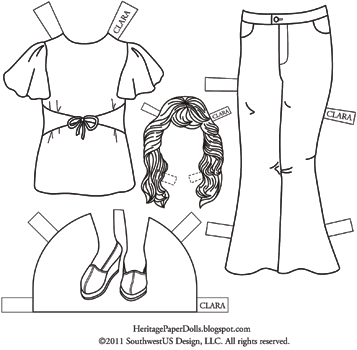
Clara's 1975 Blouse and Pants

I was watching a 1970s movie, and even if I could have ignored the cheesy acting, the clothing was hilarious. The outrageous hairstyles and clothing made me wonder if any clothing from that decade could be worn today without everyone knowing it was a vintage outfit.

I looked for "timeless classics" for a while, but all of the clothing from the 70s is immediately identifiable and very dated. The huge collars, modern-art or floral fabric patterns, bell bottoms, platform shoes, wrap dresses, and fitted blazers are all iconic of the 70s.

I did find one design for a blouse that would make a really cute, stylish blouse today. The original had an outrageous modern art design inset with a red gingham print. In a different fabric, it could be worn today. The blouse has butterfly sleeves, and two triangular insets on the bodice.

Clara's pants are bell bottoms. Originally made of a nice thick rayon. Eek.

Clara has some hair in a feathered "wings" style, similar to Farrah Fawcett's hairstyle in Charlie's Angels. I tried to make the cutting lines as simple as possible, but the hair still turned out pretty tough to cut out. Apologies for that. The hair does look pretty cute when it is on Clara, and won a complement from my youngest daughter. Tuck the dotted line tabs behind Clara's neck, and leave the rest of the hair in front of her shoulders.

Clara's shoes are some cute espadrilles. The thick platform soles are similar to shoes in style now, but the actual styling of the shoes is classic 1970s.

To print Clara's outfit, use this PDF file:
Clara's Dress 37 (749k)

Clara is a free, printable paper doll. Clara will continue to be available on this blog as long as I post new fashion pages for her. You can read the introduction for the Clara paper doll here.

To print the Clara paper doll, use this PDF file:
The Clara Paper Doll (745k)

Thursday, November 24, 2011

Clara's 1620 Pilgrim Dress

This vintage Thanksgiving card has a typical cute Pilgrim girl wearing a long black dress with a big white collar, wide cuffs on her sleeves, and a white apron. For accessories, she has a huge white bonnet and clunky black shoes with big buckles. The stereotyped Pilgrim is immediately recognizable as a symbol of Thanksgiving. Unfortunately, the dress is almost certainly not anything a Pilgrim would have worn. The only historically accurate items in this photo are the apron and the cuffs on the sleeves.

In reality,  a real Pilgrim girl from the 1620s would be more likely to wear almost any color besides black: purple, brown, red, green, yellow, or blue. The colors were probably muted, since the cloth was colored with vegetable based dyes. Even a wealthy girl who could afford the more expensive black cloth for a dress would only wear such an outfit on Sunday or for special occasions. Pilgrims had no religious objections to bright, fashionable clothing like the later puritans did, so many colors would have been worn. The later Puritans wore more sober clothing, and their fashions are perhaps what later artists (not worried about accuracy) used to create a "Pilgrim."
 
In Clara's more authentic Pilgrim dress, you may be able to recognize the Dutch influence in the style of clothing. Dutch styles and colors were popular in England at the time of the Pilgrim's journey to America. See if you can find similarities between the dress in this Frans Hals painting and Clara's Pilgrim dress.

In terms of actual fashion, a girl would have worn underclothing, a chemise (undershirt), a bodice or overdress, petticoats, a skirt, an apron, stockings, shoes, and a hat or bonnet. The bodice usually matched the skirt, and was sleeveless. It was worn over a chemise, which was usually a different color than the bodice. The stylishly narrow collar and long sleeves of the chemise were all that would show under the bodice. Wrist ruffs and turned-back cuffs were popular on sleeves for many, many years. Also, sometimes a ruff might be added to decorate the neckline.

Although Pilgrims are typically shown wearing huge buckles on their shoes, buckles were not fashionable or readily available. Buckles would not have been worn on shoes nor hats until the late 1600s. In the 1620s, shoes were tied with a ribbon or leather strips. Clara's shoes have round toes, low heels, cover most of her foot, and are tied neatly with a ribbon.

Clara has a tight-fitting bonnet – also called a coif or biggin – which she would wear daily to keep her hair clean. She may have worn a floppy felt hat in the same style as the men of the time. Women also commonly wore wide straw hats over their bonnets in the summer as they worked outdoors. However, the bonnet was the most common head covering at the time, although probably not with the huge wings most cartoon pilgrims wear.

To print Clara's outfit, use this PDF file:
Clara's Dress 36 (717k)

Clara is a free, printable paper doll. Clara will continue to be available on this blog as long as I post new fashion pages for her. You can read the introduction for the Clara paper doll here.

To print the Clara paper doll, use this PDF file:
The Clara Paper Doll (745k)

Tuesday, November 15, 2011

Clara's 1928 Cape and Dress

In the 1920s, fashion designs changed radically. Instead of simply changing the shape or decorations on the dresses, the entire approach to fashion design changed. It became socially acceptable to wear short skirts — and even pants — and the corsets of the past ended up in the attic. This dress is a little outside the normal silhouette that was iconic in the 20s: a straight-down "flapper" dress like Clara's other 1920s dress here. However, as popular as the flapper dress was, other styles were worn

Clara’s dress is from about 1928, and has long, straight sleeves, a plain bodice with a simple collar, and a knee-length flared skirt. The plain styling of the dress is dressed up with a little bow and a ribbon belt with a shell buckle. A little half-cape provides style, but not much warmth.

Clara also has some soft “bar” style silk slippers.  "Bar" shoes were simply shoes with a strap, making dancing a lot easier. The strappy heels of the 1920s are pretty neat shoes, many with intricate crossed straps. In this case, Clara's are rather plain to match the simple style of this dress.

To finish the outfit, Clara has a floppy-brimmed cloche-style hat, with a cute ribbon and some little roses for trim. This style of hat was worn fashionably when it was pulled down to just above the eyebrows, covering the forehead.

The original dress is dark green with a red ribbon belt. The cape is the same shade of green, with a matching red lining and buttons.

The shoes are white silk shoes with peach trim

The hat was baby pink with rose pink stripes, and white and pink roses.

Popular colors in the 1920s included a lot of brown, ivory, and pink. Light yellow, and many shades of green were also prevalent. Here are some colors found in 1920s clothing:


To print Clara's outfit, use this PDF file:
Clara's Dress 35 (749k)

Clara is a free, printable paper doll. Clara will continue to be available on this blog as long as I post new fashion pages for her. You can read the introduction for the Clara paper doll here.

To print the Clara paper doll, use this PDF file:
The Clara Paper Doll (745k)

Tuesday, November 8, 2011

Clara's 1915 Layered Dress

In the 1910s, shaped silhouettes and clingy, flowing material were all the rage, as the Art Nouveau movement finally began to influence fashion designs. Art Nouveau was an artistic style with very romantic subjects, flowing lines, and stylized florals. Asian influences added to the flowing nature of fashions in the 1910s. You can see similarities between this week's dress and two others from the same decade: a Sailor Dress and a Long Tunic.

Layered skirts came into fashion, and Clara’s 1915 dress is one example of the layered style, with three soft layers in the skirt. A wide, drapy yoke covers most of a loose shirtwaist – maybe otherwise known as a blousy top.The high neck is decorated with a pretty lace collar, and the belt also has a decorative floral brooch.

During the 1910s, hats lost some of the excessive trim so popular in the preceding decade. Simpler hats came into style, with the rims starting out wide, and ending up pretty narrow by the end of the decade. Clara’s hat is a simple wide-brimmed felt hat trimmed with an ostrich feather, worn on an angle.

For footwear, many styles of shoes were worn in this decade. Slippers, strappy shoes, and high heels were popular. Clara's shoes this week are tall boots, which continued to be in style through the 1910s.

To print Clara's outfit, use this PDF file:
Clara's Dress 34 (788k)

Clara is a free, printable paper doll. Clara will continue to be available on this blog as long as I post new fashion pages for her. You can read the introduction for the Clara paper doll here.

To print the Clara paper doll, use this PDF file:
The Clara Paper Doll (745k)

Clara's 1841 Easter Rose Dress

Clara's dress for this week is a reposted copy of her pretty day dress trimmed with roses, suitable for Easter. In the 1840s, the slope-...